words@bld50 monthly talks

19.10.09

The Victorian Bushfires: Recovery + Reconstruction

PANEL TALK
+
EXHIBITION


At RMIT bldg 50, Orr St, Carlton (off Victoria St, between Lygon and Cardigan)

Thursday, 5 November 2009

Exhibition opens from 6:30 PM
Talk starts at 7:00 PM

This is our last words event for 2009 and it's going to be a big one! Another bushfire season has recently commenced and we've secured four speakers to address the recovery process since Black Saturday and the challenges that lie ahead, each from a unique professional perspective. It's also an opportunity to exhibit the work of those architects who rose to the challenge responding to the aftermath through design, many in a pro bono capacity, and 17 projects will be exhibited on the night.

The wake of the devastating Victorian bushfires of 2009 was met with a massive public outpouring of emotion and support and an equally powerful wave of criticism of existing defence mechanisms and political rhetoric that produced the 'we will rebuild' mantra. Nine months on, we will reflect on the progress and lessons learnt thus far and the ongoing longterm recovery process. What are the prospects for the longterm recovery and rebuilding of devastated communities? Are vulnerable communities any better prepared for this summer? How might built environment professionals respond to the challenge of planning and designing for areas at risk? These are just some of the questions that we will discuss in our November edition of Words@bldg50.

The panel consists of:

DR SUSIE BURKE BA(Hons), PHD, MAPS. A psychologist working at the Australian Psychological Society. A significant focus of her work in the Public Interest Team at the APS is looking at the role that psychology can play in helping us understand the causes, impacts and solutions to climate change and other environmental threats, including natural disasters.

GREG BOX Manager of Arts, Culture & Heritage, Shire of Yarra Ranges. Greg oversees six cultural facilities, a cultural development program, an indigenous collection, public art and festivals and events. He was in control of the Healesville Relief Centre on Sunday, 8 February.

BEATRIZ MATURANA Architect, MA in Urban Design. President of Architects for Peace. Beatriz has worked in community development in countries including Nicaragua and East Timor, and is a passionate advocate for social justice. Her paper 'Victoria's Bushfires: isn't it time to reflect on new urban strategies?' was written in response to the 2009 Victorian bushfires.

Chair ANTHONY MCINNENY Practicing urban artist, studio leader in the RMIT Art in Public Space program and Coordinator, Cultural Planning and Development at the City of Knox. Anothny has worked in the developing world in the area of cultural restoration after human-made and natural disaster.

An exhibition of 17 design projects for areas affected by the bushfires this year will be presented on the night. These projects showcase different responses and solutions to the reconstruction process.

The exhibitors are:

Zen Architects
Irons McDuff Architecture
Tom Morgan/Sharkmouse
Hayball Pty Ltd
Splinter Society
Architects Eat
Edwards Moore
Julie Firkin Architect
John Wardle Architects
Clare Cousins Architecture + Interior Design
Monash University Architecture students
Umberto Emoli
John Henry
Emergency Architects Australia (with Antarctica/BVN/ARG/Architectus)
Clinton Murray (with S2F)
John King Architects
pH Architects

Entry by gold coin donation, refreshments provided. We hope you can join us for the last time in 2009!

29.1.08

Challenges of Post-Disaster Housing Reconstruction in Asian Communities

Challenges of Post-Disaster Housing Reconstruction in Asian Communities
Presented by K. Iftekhar Ahmed, PhD
February 7, 2008. 7pm, RMIT bld 50 (Orr Street, off Victoria Street) Gold coin donation

Asia is the most disaster affected continent and low-income communities there are often the most vulnerable to hazards. In this context, post-disaster housing reconstruction projects are implemented by various agencies with the aim of alleviating the sufferings of disaster victims. This presentation will focus on post-disaster housing reconstruction projects in Vietnam, Bangladesh and Indonesia that I have been involved in.

In Vietnam, the project was implemented by the Asian Disaster Preparedness Center (ADPC) and the Center for International Studies and Cooperation (CECI) in response to Typhoon Xangsane in 2006. The project in Bangladesh was concerned with large-scale housing reconstruction as part of a recovery programme by the United Nations Development Programme (UNDP) after the large floods of 2004. Currently I am working with a research team at the University of Melbourne on assessing the sustainability of houses built in Indonesia after the Indian Ocean tsunami of 2004 and the preliminary findings of this study are now evident.

Tremendous challenges remain in matching these projects to the needs and aspirations of communities. These case studies point to potential for good practice, but also highlight the variety of challenges that can arise, indicating ways how agencies might possibly address them.
(Click on image to downl;oad or print a poster)


About K. IFTEKHAR AHMED, PhD
Visiting AcademicFaculty of Architecture, Building & Planning
University of Melbourne

Iftekhar had been teaching at the Bangladesh University of Engineering & Technology (BUET) during 1992-2004. Additionally, he has worked extensively as consultant for various building and disaster related projects, including for the United Nations Development Programme (UNDP) in Bangladesh on family shelter reconstruction as part of a large post-flood recovery program during 2004-05. He also designed the curriculum and worked as coordinator of the Postgraduate Programs in Disaster Management at BRAC University, Bangladesh, which began in 2005. Iftekhar joined the Asian Disaster Preparedness Center (ADPC) in 2006 and was responsible for managing the PROMISE (Program for Hydro-Meteorological Disaster Mitigation in Secondary Cities in Asia) country projects in Bangladesh, Pakistan, Philippines, Sri Lanka and Vietnam. He also assisted in ADPC’s regional and national training courses, particularly the Community-Based Disaster Risk Management (CBDRM) course.
Iftekhar has worked in several other countries including Germany, India, UK and USA. Presently he is working as a Visiting Academic at the University of Melbourne, Australia on developing safer housing options for low-income Asian communities. Iftekhar completed his doctorate from Oxford Brookes University, UK and Master of Science from the Massachusetts Institute of Technology (MIT), USA. He graduated in architecture from the Indian Institute of Technology (IIT), India. He is a member of the Institute of Architects, Bangladesh and has several publications and books to his credit.

19.7.07

Reclaiming poisoned land: Reconstruction and renewal in post-war Lebanon - 2 August 2007

Public lecture
Thursday 2 August, 7.00 pm
RMIT Building 50, Orr St, off Victoria St

Speakers:

Dr Hadia Haikal Mukhtar, Medical Association for the Prevention of War + Mounir Kiwan, Australian Lebanese Youth Association

Following the war in July 2006, Lebanon faced a humanitarian crisis, with more than 1000 people killed, more than 4000 injured and around 1 million internally displaced. This was compounded by an environmental disaster caused by an oil spill in the Mediterranean Sea, the destruction of infrastructure and dwellings and the littering of South Lebanon with cluster bombs.

Estimated at over a million in total, these bombs represent a serious and largely invisible threat to the lives and livelihoods of civilians struggling to rebuild. The use of such weapons ensures that conflict leaves a long term stain on regions devastated by war, well after cease-fires have been called.

Dr. Hadia Mukhtar, a member of the Medical Association for the Prevention of War, visited the country in December last year as part of a humanitarian delegation organised by Australians for Lebanon. Dr Mukhtar will be joined by Mounir Kiwan, president of the Australian Lebanese Youth Association, to discuss their first-hand insights into the work of NGO’s aiding the relief effort, and the ongoing campaign to outlaw the manufacture and use of cluster bombs.

Lecture to be followed by discussion and refreshments. Entry by gold coin donation.

26.6.07

Andrea Nield from Emergency Architects Australia - July 5th, 2007


Free public lecture
Thursday 5th July, 7pm onwards
at RMIT building 50, Orr St, Carlton.


"The fundamental question we asked...was if architects are able to become organized in exceptional circumstances during major crises,as other professionals have done before"

Since forming in April 2001 in France after the floods of the Somme and the Oise, Emergency has been endeavouring to answer this question.

In the process, members have worked to mobilise built environment professionals in order to provide immediate assistance in the event of natural and human-made disasters. Most recently, it has been involved in assessing the earthquake damage suffered in the Solomon Islands. Andrea Nield, director of the Sydney-based arm of Emergency Architects, will share her hands-on experience in post-disaster recovery and re-building.

Hear about the principles and goals driving Emergency Architects, and the projects where these objectives have been put to the test.

To find out more about Emergency Architects see
http://www.emergencyarchitects.org.au/.
For more details on the presentation contact
eleanor@architectsforpeace.org

16.5.07

Neighbourhood house project in Timor Leste - 7th June, 2007


Public lecture on the past and future of a neighbourhood house project in Timor Leste.
Thursday 7th June, 7pm onwards
at RMIT building 50, Orr St, Carlton.


The cities of Yarra and Darebin in Victoria developed a Friendship Agreement with the province and township of Baucau following Timor Leste's independence. At next month’s words night, members of Friends of Baucau and Yarra and Darebin councils will speak about a recent building project in Timor Leste. With the help of agencies including Australian Volunteers International and the Rotary Clubs’ Roofing Project, a building damaged during the independence violence was restored and established as a neighbourhood house.

Friends of Baucau are planning to restore a building adjacent to the Buka Hatane neighbourhood house and on the night will be presenting details of the new project and happy to speak to anyone interested in getting involved.

Speakers will include Clare Murrell, Project Officer at Friends of Baucau and Roderick McIvor, Manager of Social Policy at Darebin City Council. More details coming soon! In the meantime, please contact Eleanor for further information at eleanor@architectsforpeace.org

Refreshments and discussion will follow. This is a free public event, made possible by the time and effort contributed by speakers and members of Architects for Peace. A gold coin donation on the night helps to cover our overheads so that we can continue to provide an alternative forum for issues concerning the built environment and social justice.


4.9.06

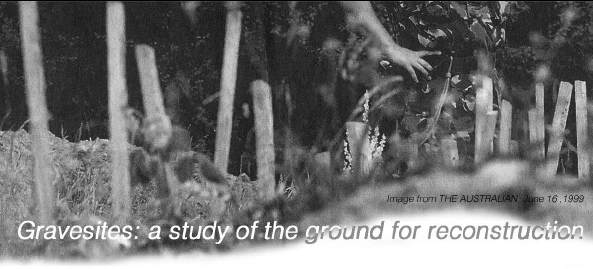
Grave sites: a study of the ground for reconstruction


7pm Thursday September 7th, at RMIT Building 50, Orr Street Carlton

Dr. Mirjana Lozanovska, School of Architecture and Building, Deakin University

Gravesites: a study of the ground for reconstruction

In a seminal essay of 1910, Adolf Loos proposed a definition of architecture,

“If we find a mound in the forest, six foot long and three foot wide, formed into a pyramid shape by a shovel, we become serious and something within us says, ‘Someone lies buried here.’ This is architecture.”

Loos’s mound of earth suggests that death and burial are central to the conception of architecture. Ceremonial burial revealed even in excavations of thousand year old sites, through traces of flowers and offerings, exemplifies that the symbolism of death is profoundly integral to humanity. In striking contrast , mass graves found after the war in former Yugoslavia, Bosnia (1992-1995) and Kosovo (1999), were represented as the opposite to these positive dimensions of humanity and specifically as the horror and cruelty of a particular race and culture of people. The gravesite during and after war becomes a contested territory of emotion and representation. It does not yet attain the symbolic place of the monument and tomb. These two sides of human civilization, the former perceived as the epitome of civilization as it ties death with ritual and memory, and the latter as evidence of the cruelty of humans, are tied through death. The latter integrally ties death with war, and its excesses of destruction and violence.

This presentation will focus on Kosovo and the former Yugoslavia, and will firstly present a history of the war and destruction, and the resulting gravesites, as a context for the discussions to follow. Reports on mass graves in Kosovo will form the basis for an analysis of the media, especially about places the readers tend to know little about. The presentation moves towards a more reflective discussion about the land and country after war as an extended gravesite. Drawing on psychoanalytic theory, an examination of the gravesite yet uncertain about its potential as symbolic of death rather than as evidence of hatred and destruction, will be elaborated. Underlying the thesis of the presentation is the question of post-war reconstruction, and how to address the gravesite as ground for architecture.


PAST WORDS...
| download all posters: here |