A-public Space Projection: virtual competition / exhibition/intervention

0
comments

 in:
art,
city,
disaster,
infrastructure,
landscape,
urban
in:
art,
city,
disaster,
infrastructure,
landscape,
urban

 in:
art,
city,
disaster,
infrastructure,
landscape,
urban
in:
art,
city,
disaster,
infrastructure,
landscape,
urban
| words@bld50 monthly talks |
in:
art,
city,
disaster,
infrastructure,
landscape,
urban


Words@Bldg50 October Edition:
Landscape food paradigms, with Michael Howard
Much of the current conversation around new food paradigms has a focus on domestic urban production . A boutique model that will come and go and have little affect on our broader food world . How can we shift these paradigms of production across a range of scales without loosing the the energy currently generated by the community groups? What are the considerations and how can we engage with them through design. The role of design is often ignored in this area of agriculture and considered only through pragmatics. What else can working landscapes offer and how do we infiltrate what we understand as closed industrial sites?
Will be joining us is Michael Howard. Michael is a founding member of FOODLAB: Food and landscape architecture bureau and lectures in landscape architecture at RMIT University, Australia. His research interests include food systems, productive landscapes and designing for future food urbanism. His design teaching focuses specifically on the spatiality of food systems in urban, regional and remote Australian Landscapes. His recent projects have investigated ideas around efficiency, redundancy and cross programming of peri urban food production zones in Melbourne Australia.
Join us for an evening of talk and conversation, followed by light refreshments. Entry by gold coin donation.
Video of the event:
Part 1
Part 2
Q&A
in:
city,
development,
ecology,
food,
landscape,
urban
 At RMIT bldg 50, Orr St (off Victoria St), Carlton
Silvia Acosta, architect and professor at the Rhode Island School of Design in the USA, is a visiting academic at Monash University's Department of Art + Design in August. She finds opportunities for student engagement in practice-based projects, and values a “hands-on” approach as a way of doing. Investigation topics are often developed in relation to issues of community and the public realm. Silvia has undertaken community-based design-build projects in Mexico, Costa Rica, Japan and the USA.
Silvia says:
"Collaborative efforts often outweigh work conceived from a singular or individual point of view; working jointly on a project is one way of forming “community.” In making community, everyone involved leaves marks without being concerned about whose handprints are in the work. Collective decisions are made through different points of view, yet these diverse outlooks share a common ambition to make something contributing to the greater good. Architectural practice is often collaborative—involving many minds and hands, an ongoing exchange of ideas and crafts. While a kind of art form, architecture is not an isolated art; it is bound to a multitude of intersecting circumstances. Part of one large human art, it tries to understand the physical world, shape it and make room for living in it.
 Our quest as artists and architects is to discover and articulate what we value. We seek out situations where a contribution might be made in an attempt to improve the lives of individuals, or the qualities of a place in some way. The work we make as architects comes from us, mirrors our reflections and longings, and yet, it is never ours; when finished, it is given away to others. So, how can we propose guidelines for a work of architecture that induces active exchange among its makers—a sense of community among the people it serves?"
Entry by gold coin donation, refreshments provided.
(Images from Silvia's community-based work in Mexico, Japan and the USA)

At RMIT bldg 50, Orr St, Carlton
(off Victoria St, between Lygon and Cardigan)
Renewal and revitalisation are buzzwords around town. Drawing on preliminary findings from current research in Dandenong and Footscray, both presently subject to R & R processes, Maree Pardy considers a range of questions related to the promises of and visions for the renewal of these suburbs. Qualitative research in both suburbs has so far involved interviews, observations and conversations with policy and planning personnel, visitors, local residents and retailers. Both suburbs share rich yet diverse histories of class, socio-economics and immigrant and refugee settlement. Both also share a distinctive element of cultural diversity, which has been central to much discussion about their branding and futures. Yet, while cultural diversity is discussed, multiculturalism seems to have disappeared from many agendas.
Focusing on the difference between cultural diversity and multiculturalism, Maree will present some of the differing relations to ‘place’ among urban designers, social and urban planners and the many and diverse individuals and groups who inhabit these suburban spaces. The difference between cultural diversity and multiculturalism is outlined and deployed to suggest the possibility of an interesting discursive split arising here, as these suburbs are differentially imagined as spaces of display and/or spaces of dwelling. Maree will explore some prospects and risks that emerge from and within this split.
Dr Maree Pardy is an anthropologist who researches in the areas of multiculturalism, gender, and immigrant communities in urban Melbourne. She teaches in the Gender Studies program in the School of Philosophy, Anthropology and Social Inquiry at the University of Melbourne. Maree has presented a number of papers dealing with areas including identity, nationalism, multiculturalism and globalisation and authored the article "Kant comes to Footscray Mall—thinking about local cosmopolitanism" in the 2005 publication Sub Urban Fantasies. Her current research project ‘Urban revitalisation, public space and intercultural encounters’ is being undertaken with Professor Ruth Fincher, Professor Ghassan Hage and Ms Cathy Henenberg.
Download the PDF flyer for this event here
Entry by gold coin donation...refreshments provided
in:
city,
public space,
urban
When: Thursday 6 November 2008, 7pm
Where: RMIT building 50, Orr St, Carlton
TRESPASS is the subject of our next lecture night. This idea has emerged from our probono committee's recent involvement with the Student Housing Action Collective (SHAC), a group currently occupying a vacant Melbourne University property in protest against the cost of student housing.
We'll be joined by members of two very different groups that have both grabbed media attention recently for their unconventional mis-use of urban space: Cara Wiseman, a participant in last September’s PARKing day in Melbourne and two residents from SHAC.
Note: We will be requesting a small donation of a needed item for the SHAC residents rather than the usual gold coin donation. Some needed items are listed below:
soy - milk - rice - beans/pulses - canned tomatoes/tomato paste - onions - honey - peanut butter - muesli - tempeh - walnuts/nuts - coffee - vacuum cleaner - can opener (!) seedlings - esp. shade friendly plants - seed raising mix (!) bread knife (!) knife sharpener (!) master plunger (!) towels - bath mat - face towels - tea towels - lamps - YOU - computer - coffee perculator large - fairylights
Click here to download the flyer.
Learn more about the international PARKing movement or read up on SHAC in the news.
in:
city,
urban
 7pm Thursday 1st May
 in:
city,
earthquake,
Tokyo,
urban
in:
city,
earthquake,
Tokyo,
urban
Impressions of Turkey:
by C. 
An important aspect for me is the relationship between architecture and nature. Respect for animals is not only expressed in heritage buildings, which provided shelter for humans, other mammals and birds. Water, which is freely offered in the many fountains, provides the public with a free collective service while embellishing the cities. Cities embody life and spontaneity that cannot be contained, vibrancy that does not need to be artificially created to exist.
In Istanbul, the quality and magnitude of the city’s centre public space - where living, working, visiting, modernity and history intermingle, give the impression of a genuinely vital urban centre, not characteristic in market driven cities or of over regulated societies.
For anyone interested in this topic, I found a book by Cengiz Bektaş called Kuş Evleri or Bird Houses. I have collected some photographs and I hope that they convey, at least in part, the wealth and multiplicity of the public space.
To see my collection go to: ArchNet
in:
city,
culture
 Public Space - Art and Urban Planning
ARC Biennial
Art, Design and Craft Biennial, October 20 – 30 2005
Brisbane City Hall, Queensland, Australia
Anthony McInneny
This is an edited version of a paper presented by Anthony McInneny on behalf of Architects for Peace as one of a panel of three speakers that included Timothy Hill (architect and partner of Donovan Hill) and Jay Younger (associate professor at Queensland College of Art). The panel was to respond to the following question:
“If public art is an essential feature of a well-designed city, why are so many projects deemed failures? Panelist discuss the future of public art, and the responsibilities of planners and decision-makers to the public (and vice versa)”
I was invited to speak on this panel in response to an overview I wrote of a conference entitled IntentCity conducted by Architects for Peace. The conference was ambitious; free to the public, outdoor in a public space and funded by individual members, not a government department. One of the central ideas of the conference was to discuss the political city in a new space claimed for public debate rather than passive recreation.
When I think of Public Art, my mind immediately imagines objects in public spaces. The evolution of public art practice has been successful in extending the notion beyond sculpture in public spaces and has skilled up, as it were, visual and performing artists to work in the public realm and collaborate (or to chose not to collaborate) with other practices, agents and professions of the built environment. As Jay Younger pointed out, public art programs have provided a lot of employment for artists and is similar in many ways to a public works program for artists.
Creative processes of administration and commissioning (if that is not a contradiction in terms) have tended to shut down in the face of controversy. This is particularly the case in Melbourne spanning the Vault in the 1970’s to the recent fiasco with painted trees near the sacred MCG in 2004. Unfortunately, independent benefactors in Australia have not been keen to fund a public art program similar to the New York Public Art Fund or Artangel.
The assumption in the question for today’s panel is that we live and work within well-designed cities and that in some way public art has failed the city.
Artworks crystallize the times in which they are made and within which we live. Perhaps we not only get the politicians we deserve but also the public artworks.
“In other countries it has been well recognized that often artists are the spearhead for subsequent gentrification of areas where space is cheap”. In an argument for a national percentage for arts capital works program[1], the National Association for the Visual Arts (NAVA) proffers that “In other countries it has been well recognized that often artists are the spearhead for subsequent gentrification of areas where space is cheap”. This is probably true but I don’t remember the speculative property market as being part of the artist’s intent. Speculative property markets and speculative financial markets in general have dominated our economy, psychology, culture and public spaces. Gentrified cities and public spaces reflect a certain social agenda, one of exclusion through income and in the absence of meaningful social housing policy. How can public art in this setting reflect anything more that urban tourist attractions for the commuters or an expression of status or lost heritage for the residents?
The suburban sprawl of most of Australia’ capital cities could hardly be described as well designed. Car dependent, low density, dormitory suburbs with houses larger than can be lived in, heated or cooled and furnished with every form of entertainment as a consolation for a lack of social and built infrastructure. Without increased density in our suburbs, public transport and social infrastructure are not viable. We are trapped in an individual, car centric world that demonstrates the failures of urban planning and public policy. The city centre becomes an island and the outer suburbs, where the majority of people live, becomes less sustainable and separated from social and political life. The image of the bus stop/ad shell is included for a number of reasons.
It reminds me of the visual pollution created throughout our cities as we abdicate our right to not be subjected to propaganda in our most public of public spaces. It would appear that this form of rented public space is the only way this country can afford a second rate commuter transport system.
I have a sense of nostalgia for the idea that I once caught a piece of public artwork. The W class trams of Melbourne, painted by established and aspiring artists, were a quaint notion of public art in the late 70’ and 80’s. We now stand at billboards and consent to catching and becoming part of advertising campaigns.
A recent artwork I developed was not able to be located on the preferred site because, in part, it obscured the view of such an advertisement.
Lastly, it is not unusual for advertising and art to appropriate one another but this reproduction of Holbein’s Ambassadors has a peculiar twist. The anamorphic skull representing mortality has been removed for no apparent reason.
While the streets of CBD Melbourne are full of public artworks, very few actually deal with the notion of public space in any more successful or meaningful way than the monuments of conquest and war that dominated Australian cities for over half the 20 Century. Perhaps the comparison with these monuments is not too far off the mark. What types of memorials will be made for the War on Iraq and the never ending War on Terror? Perhaps we are making them in our cities and as artists in a state of amnesia or denial. In another step into this twilight zone, historic monuments for “just wars”, WWI and WWII, are being stripped of their relevance, their site specificity as it were, by being relocated from public places of daily life to memorial precincts or closer to the club for the diggers. The example illustrated is the First World War bugler to be relocated from the major intersection of Station Street and Whitehorse Road in Box Hill at the request of the local RSL.
In a similar fashion, art precincts are the resting place for tired or problematic public artworks. Most notably, the Vault has found its final resting place in the public space surrounding its architectural equivalent, the Australian Centre for Contemporary Art, ACCA. A recent exhibition at ACCA during the Melbourne Festival was an empty room with the light switched off by the exhibiting artist who works in the public domain, Martin Creed. This is epic stuff according to the experts. An easily dismissed one-line joke becomes disturbingly serious when art teachers, with VCE students in tow, explain how they become part of an artwork by entering a dark room.
The most recently created public space in Melbourne, Federation Square, is a cluster of commendable cultural and institutional buildings that surrounds an open air, undulating public artwork by Paul Carter. This work forms the surface of the square that dissuades sitting, standing or any other activity for that matter except for consumption on the perimeters in cafes. Like a 1950’s house on a quarter acre block that ignores the backyard, Federation Square turns its back on the Yarra River and, to complete the suburban metaphor places a large screen television as the dominant feature in the corner of this public living room. When guests arrive, and I would argue that we are all guests in Federation Square, you have to turn the telly down or off if you want to talk but please, don’t sit on the new furniture because there is nowhere to sit.
The most symbolic of our public institutions, the new Parliament House in Canberra was designed with a gesture to the public. Able to walk over Parliament House, we demonstrate participatory democracy. While down the hill, the Aboriginal embassy struggles to maintain it’s heritage status in front of the Old Parliament House turned into yet another museum of democracy, a fitting end to the idea that parliament actually represents people was a community/public art project commemorating the Centenary of Federation. 1000 cardboard cutouts of significant members of our communities, nominated and decorated by citizens were the last people to walk on the grass roof of parliament house. This was 2001 just before the barricades went up.
“In line with a review of security and access, the commissioning body is pursuing opportunities to incorporate landscape and artwork as elements which not only increase the amenity of the reserve, but will limit car access to sensitive government buildings[1]”
“In line with a review of security and access, the commissioning body is pursuing opportunities to incorporate landscape and artwork as elements which not only increase the amenity of the reserve, but will limit car access to sensitive government buildings[2]”
This is an excerpt of an “Artist’s Brief” I recently received and, perhaps foolishly, submitted my resume as an expression of interest. The only other surprise was the fact that the turn around time on this project from concept to installation was less than four months. This is a project for a major site in Melbourne CBD. This is not an isolated case in the flurry of developments and events for the Commonwealth Games in March 2006. All briefs have an agenda, even straight commissions but I have never seen one that explicitly states that art should be a security barrier.
The trouble with commissioning bodies that are public institutions or instrumentalities is not that they have a constituency to which they answer but that very few of the people who represent or have power within these bodies actually value art for what it is, not what it does. There is an almost total disregard for the artistic process to develop a response to a site over a period of time. Art is not simply a design process.
One would be naïve to think that a government or private developer would actually fund works of dissent. What is less apparent is that the room for dissent to actually exist is being squeezed out of public space.
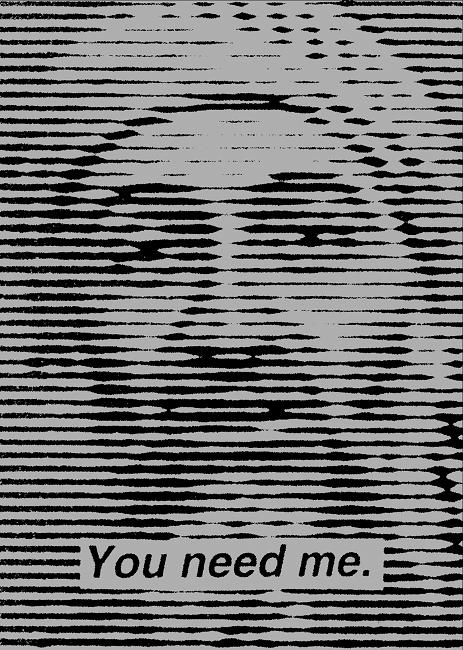
I am a great supporter of the City of Melbourne. I believe that many of its programs are artist focused. I am a member of the Public Art Advisory Committee. The work illustrated is the work of Aslan McClennan. This is part of a body of work that was deemed unacceptable for the City Lights gallery. What was also unacceptable and banned from the 24/7 Gallery that is partly sponsored by the City of Melbourne was a body of works on the Israeli/Palestinian conflict. The first in this series was an Israeli flag covered with statistics about the number of Palestinians killed and significant political and historical dates and events. The second proposed work of a Palestinian Flag with similar information on Israeli casualties never got to see the light of day. The first work was ordered to be removed.
I found a subtle indication of our inability to objectively look at history in an exhibition of migrant gardens in Brisbane in City Hall today. Historical background is provided referring in one instance to the invasion of Afghanistan and in another to the Vietnam Civil War. The fact that we were directly involved in the later and not the former is not mentioned.
Moving to private public space, the Docklands in Melbourne in an attempt to incorporate artworks in public spaces has done two things badly. Individually the artworks are significant pieces. What the Docklands authority has done is to return to the notion of “plop art” and in doing so have either created an outdoor gallery for works that bare no relationship to the site or co-opted works into private spaces, the foyers and facades of buildings. This gallery and the waterfront become a forecourt for the apartments and, like Federation Square, unless you are consuming or attending an “event” there is little reason to visit. That the Docklands is actually public space in anything other than land title may change with the collapse of the investment property market.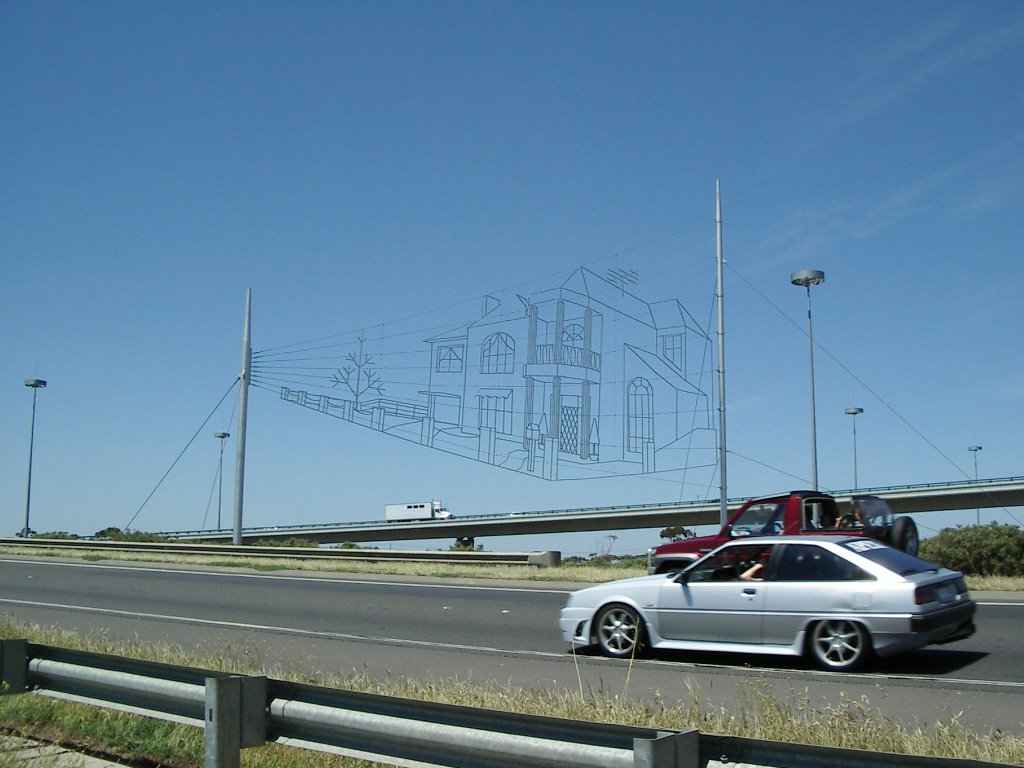 I will close my discussion with the image of one of a series of six “successful” works for freeways in Melbourne. This public art project was developed by a group of Western suburb Councils in Melbourne who are trying to convey that the traditionally working class, industrial suburbs are undergoing a transition – effectively one could argue it is part of a marketing exercise. I have chosen the work of landscape architects Sinatra Murphy who have created a full scale rendering of a McMansion in two-point perspective that floats above the clover leaf of a freeway intersection. I see this work as a public art version of the popular television series Kath and Kim. Popular because it demonstrates a reciprocal snobbery of suburban and urban living that does little to question the unsustainable nature of urban sprawl or consumption.
Figure 1: Bus shelter in Mitcham, Melbourne
Figure 2: Bugler, First World War monument Box Hill, Melbourne
Figure 3: Aslan McClennan. You Need Me. Stencil artwork for City Lights Gallery. Image courtesy of the Artist Figure 4: House in the Sky. Sinatra Murphy Landscape Architects. Western Ring Road, Melbourne.
[1] NAVA Quarterly, September 2005 No. PP242800/00004 ISBN 1032 9617
[2] Expression of Interest document from the department of Treasury and Finance
in:
city,
culture


 Posts
All Comments
Posts
All Comments